
TL;DR: US export controls on semiconductors backfired, accelerating China’s innovation rather than slowing it. Key Data: Nvidia lost a $50B annual market and suffered a $600B market cap collapse. Chinese firms exposed to controls surged R&D by 49% and patents by 65%. Breakthroughs like SMIC's 5nm without EUV and DeepSeek's efficient AI model validate a new Forced Innovation venture thesis. The policy proved counterproductive, strengthening Beijing's resolve for technological self-sufficiency while devastating American market position.
The ongoing negotiations between Donald Trump and Xi Jinping over Nvidia chip access have brought into sharp focus a critical question: Did US export controls on semiconductors slow down China's technological advancement, or did they backfire by accelerating domestic innovation? After analyzing extensive research, financial data, and academic studies, the evidence points to a counterintuitive conclusion: the chip ban has been counterproductive, spurring faster Chinese innovation while devastating American chip companies.
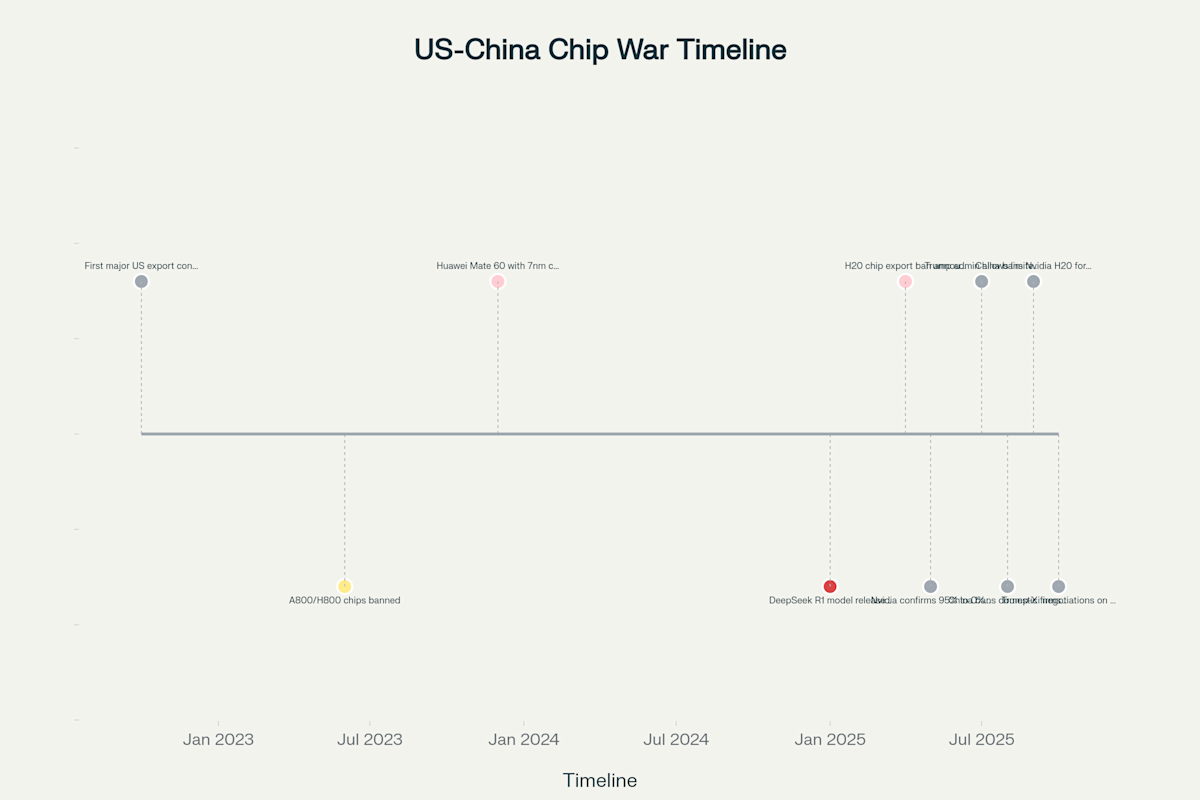
Timeline of Major Events in the US-China Chip War (2022-2025)
Nvidia's Devastating Market Loss
The financial toll on Nvidia paints a stark picture. Jensen Huang, Nvidia's CEO, confirmed in October 2025 that the company's market share in China collapsed from 95% to 0% in a single year. This represents the loss of what was once one of Nvidia's largest markets globally.
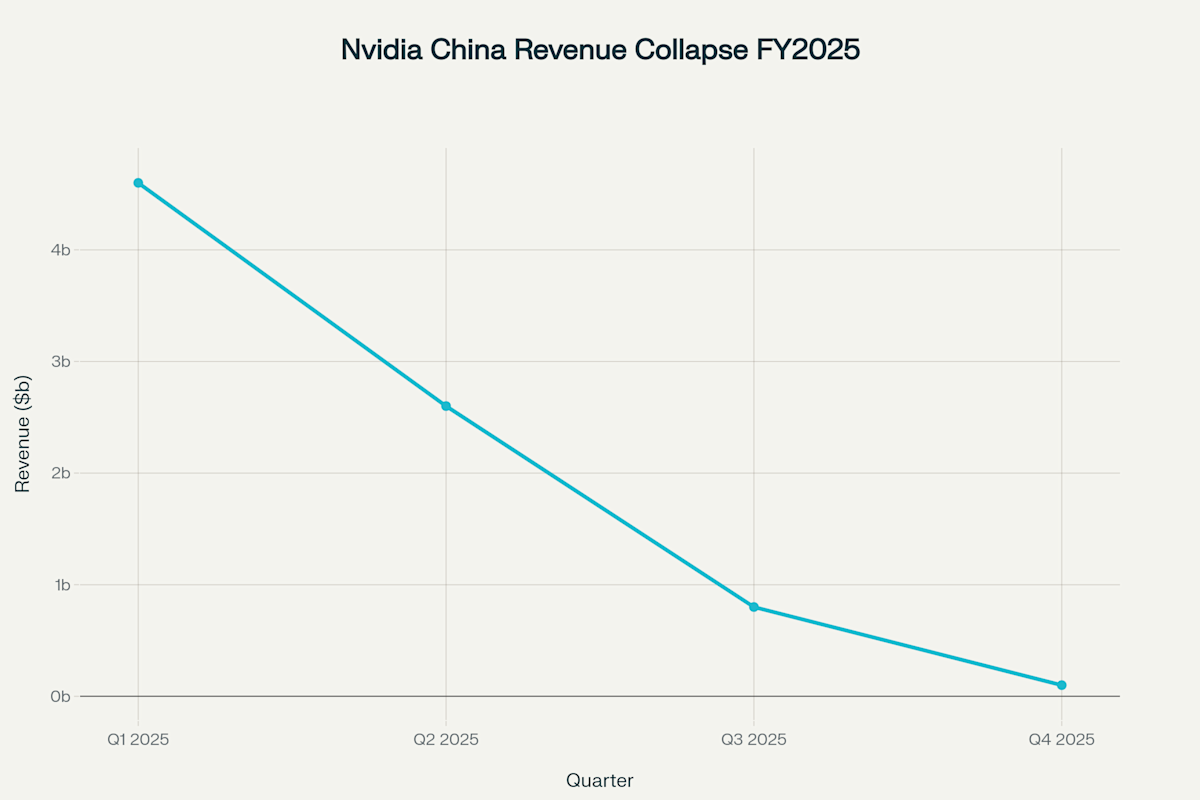
The numbers are staggering. In April 2025, Nvidia was forced to take a $5.5 billion write-off on H20 chip inventory when the Trump administration required export licenses for all China-bound chips. The company lost an additional $2.5 billion in quarterly revenue opportunities. China's AI chip market, valued at approximately $50 billion annually with 50% projected growth, became completely inaccessible to Nvidia.
Most dramatically, when Chinese startup DeepSeek released its efficient AI model in January 2025 (trained on just 2,000 older Nvidia chips rather than cutting-edge hardware) Nvidia's stock plummeted, wiping out $600 billion in market capitalization in a single day, the largest one-day loss ever recorded by an American company.
China's Rapid Innovation Response
Rather than crippling China's semiconductor ambitions, the export controls triggered an unprecedented innovation surge. Multiple academic studies and real-world data demonstrate this paradox.
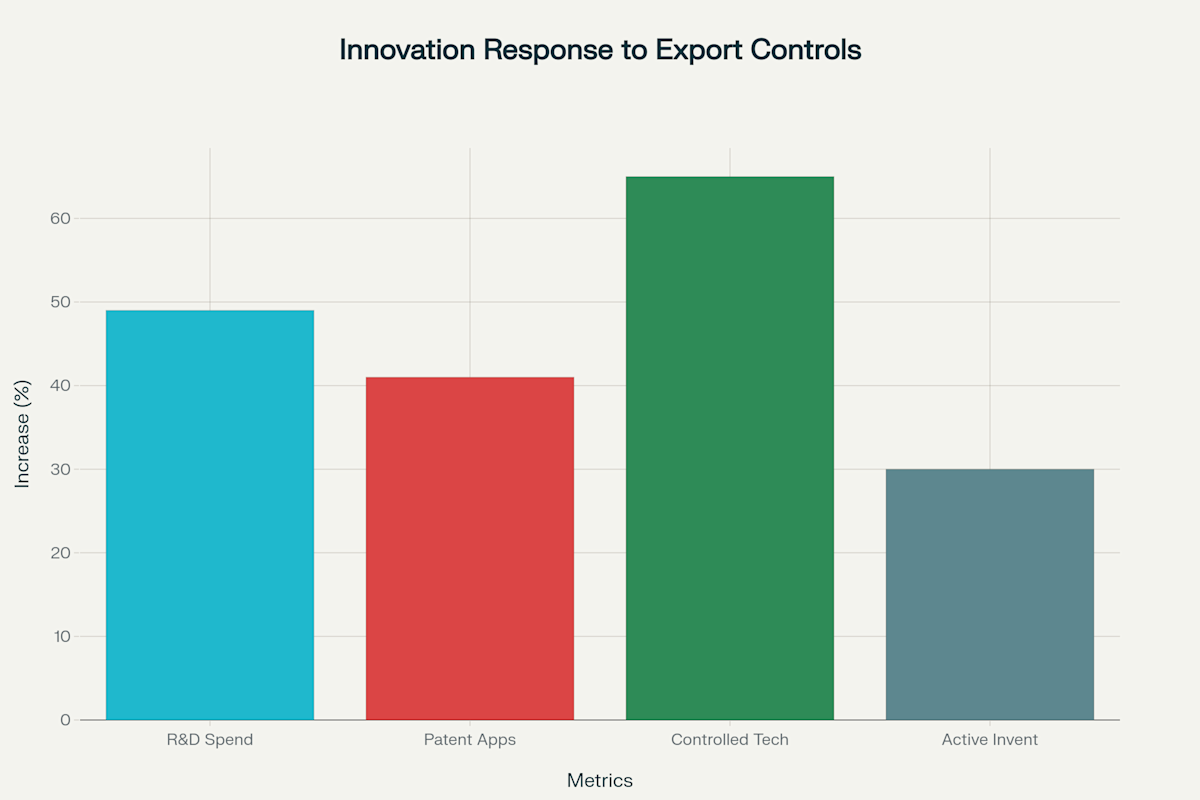
Research examining the 2007 "China Rule" export controls found that Chinese firms exposed to restrictions increased R&D spending by 49% and patent applications by 41%. Most significantly, patents in controlled technologies surged by 65%, with active inventors increasing by 30%. The study concluded that "export controls can accelerate innovation by forcing substitution".
A 2025 Harvard Business School study examining export controls on target countries found that exposed firms "are more likely to have positive R&D expenditures and more likely to hold any patent," though profitability initially declined. Research published in China Economic Review warned that technology sanctions on countries with substantial research capacity "may unintentionally narrow the technology gap" rather than widen it.
Domestic Chip Production Accelerates
The production data reveals China's remarkable progress in developing Nvidia alternatives. Huawei's Ascend AI chips have become the centerpiece of China's domestic semiconductor strategy.
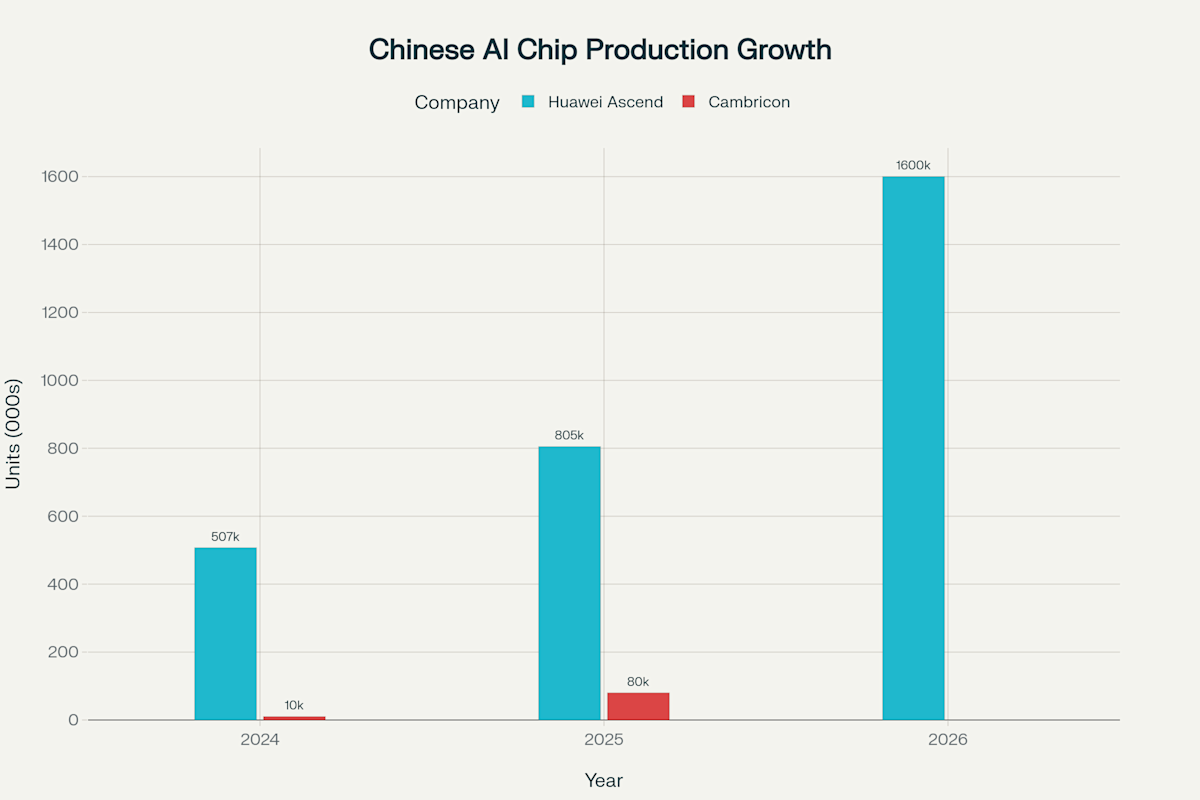
Huawei's production trajectory:
- 2024: 507,000 Ascend units shipped
- 2025: 805,000 units projected (653,000 being the advanced 910C model)
- 2026: 1.6 million dies forecasted
Critically, Huawei achieved profitability for the first time in 2025, with Ascend 910C yields reaching 40% and targeting 60% to match industry standards. The company now represents over 75% of China's overall AI chip production.
Cambricon Technologies, dubbed "China's little Nvidia," posted extraordinary results in the first half of 2025: revenue surged 4,400% year-over-year, with the company recording its first profit of $144 million. Production is expected to reach 80,000 units through 2025, potentially doubling to 160,000 in 2026.
Breakthrough Manufacturing Without EUV
Perhaps most concerning for US policymakers, China's Semiconductor Manufacturing International Corporation (SMIC) achieved what was thought impossible: producing 5nm chips without extreme ultraviolet (EUV) lithography.
SMIC accomplished this by using older deep ultraviolet (DUV) equipment combined with Self-Aligned Quadruple Patterning (SAQP), a complex multi-layering technique. While yields remain low (estimated at 15-20% for 5nm versus industry standards above 60%), the breakthrough demonstrates that China can advance node technologies despite lacking access to ASML's EUV machines, which are exclusively controlled by Dutch export restrictions.
The Huawei Mate 60 smartphone, powered by a 7nm SMIC-manufactured chip, beat Apple's iPhone 15 to market with satellite calling capabilities: a symbolic achievement that demonstrated China's progress.
Massive Government Investment
China's commitment to semiconductor self-sufficiency is backed by enormous financial resources. The third phase of China's National Integrated Circuit Industry Investment Fund (the "Big Fund") raised **344 billion yuan ($47.5 billion): **larger than the first two phases combined.
This represents just one stream of funding. According to the Information Technology and Innovation Foundation, China has "probably invested the equivalent of the US CHIPS Act virtually every year since 2014". Six major state-owned banks committed an additional 114 billion yuan ($15.73 billion) to the Big Fund, representing one-third of total capital.
China's semiconductor industry generated $179.5 billion in revenue in 2023, with a projected compound annual growth rate of 7.31% through 2027. The country produced 23,695 AI-related research papers in 2024, surpassing the combined output of the United States (6,000), United Kingdom (1,747), and European Union (10,055). China now accounts for 47% of the world's top AI researchers.
Academic Consensus on Backfire Effect
The scholarly literature increasingly supports the conclusion that export controls have been counterproductive. A TNSR (Texas National Security Review) analysis examining historical export control regimes concluded that restrictions on China "might actually be accelerating Chinese innovation through the scarcity they impose".
The study noted that Chinese companies are "figuring out how to write more efficient code for large language models to cope with the limited number of training cycles" and "experimenting with how to combine different types of chips". One Taiwanese semiconductor executive observed that export controls "are only going to force China to become even more creative and focused on using the resources that they have".
Jensen Huang himself stated bluntly in May 2025: "Overall, the export control was a failure". He explained that restrictions gave Chinese businesses "the spirit, energy and government support to accelerate their development" while forcing Nvidia to forfeit its dominant position to domestic competitors like Huawei.
A Georgetown University study found that while export controls succeeded in limiting China's share of the global AI infrastructure market (since Chinese cloud firms lack competitive hardware for international deployment), they failed to prevent Chinese labs from producing highly competitive AI models. The DeepSeek breakthrough validated this assessment.
The Shell Company Loophole
Export controls have proven difficult to enforce. Research documented that Chinese firms routinely circumvent Entity List restrictions through shell companies. When ten companies are sanctioned, "ten new companies may emerge to ensure an unhindered business flow with American suppliers and vendors, who are also keen on profitable dealings with Chinese buyers".
Huawei itself received **over 2.9 million Ascend dies from TSMC (**a violation of export controls)creating a "die bank" that sustained production through 2024 and 2025. Only when this stockpile runs out will SMIC's domestic production fully replace foreign supply.
Limited Success: Manufacturing Equipment
Export controls achieved one significant objective: slowing China's access to advanced chipmaking equipment. The Netherlands' ban on ASML's EUV lithography machine sales to China has constrained SMIC's manufacturing efficiency.
However, even this success appears temporary. China is aggressively developing indigenous lithography capabilities. Shanghai Micro Electronics Equipment (SMEE) is working on domestic systems, and reports indicate SMIC is testing machines from Yuliangsheng targeting 28nm production by 2027. While these systems lag ASML's technology by nearly two decades, they demonstrate China's determination to eliminate foreign dependencies.
A 2025 report revealed that Chinese firms have even attempted to reverse-engineer ASML's DUV machines, though one effort resulted in damage requiring manufacturer support. This incident underscores both the difficulty of replicating advanced equipment and China's willingness to pursue any avenue toward self-sufficiency.
Current Negotiations and Strategic Leverage
As Trump and Xi prepare to meet, chip access has become central to broader trade negotiations. In October 2025, the two nations established a framework addressing rare earth exports (where China controls 90% of global supply), tariffs, and semiconductor trade.
Beijing has leveraged its position strategically. After Trump initially allowed limited Nvidia H20 sales in July 2025, China turned the tables in August-September by instructing domestic firms to stop purchasing Nvidia chips pending a national security review. This move (using Nvidia's market access as a bargaining chip while promoting domestic alternatives) demonstrated China's growing confidence.
Trump's recent comments aboard Air Force One suggest chips will feature prominently in discussions, with the president stating he may discuss Nvidia's "super-duper" Blackwell chips with Xi. However, industry analysts believe Beijing views any US chip access as temporary and unreliable, cementing China's commitment to domestic alternatives.
The geopolitical dimension of semiconductor policy is inseparable from broader bond and FX dynamics, and readers looking for ongoing macro-level trade and rates coverage can find a prediction-grounded perspective at The Ledger.
The Verdict: Counterproductive Policy
The comprehensive evidence leads to a clear conclusion: US export controls on semiconductors have been largely counterproductive. While they achieved short-term revenue denial and slowed access to the most advanced manufacturing equipment, they triggered precisely the outcome they aimed to prevent: accelerated Chinese innovation and reduced long-term dependence on American technology.
What worked:
- Restricting EUV lithography equipment sales slowed China's manufacturing efficiency
- Creating immediate disruption to Chinese tech firms' access to cutting-edge chips
- Limiting China's ability to compete in global AI infrastructure markets
What backfired:
- Nvidia lost a $50 billion annual market while Chinese alternatives flourished
- Export controls provided Chinese firms with "spirit, energy and government support" (Huang's words) to accelerate domestic development
- Academic research shows exposed firms increased R&D by 49% and controlled-technology patents by 65%
- China achieved unexpected breakthroughs (5nm without EUV, DeepSeek's efficient training)
- Forced technology transfer and supply chain localization that might otherwise have taken decades
A Brookings Institution analysis warned that current sanctions "will likely prove inadequate to meet the policy goals" and noted Huawei's ability to create homegrown chips "with unanticipated speed". The ITIF (Information Technology and Innovation Foundation) titled its 2025 report "Backfire: Export Controls Helped Huawei and Hurt U.S. Firms".
The fundamental flaw in the policy lies in underestimating China's research capacity and overestimating the timeline for transformative AI development. As one legal scholar noted, if AI breakthroughs take a decade rather than 2-3 years, "China may achieve semiconductor self-sufficiency in the interim. This would render the controls counterproductive by accelerating China's technological independence".
The Path Forward
The data suggests a recalibration is needed. Rather than blanket restrictions that strengthen Beijing's resolve and damage US companies, a more nuanced approach might include:
Selective controls focused on the most militarily sensitive applications rather than broad commercial bans
Multilateral coordination with allies to prevent circumvention while maintaining enforcement consistency
Domestic investment to maintain US technological leadership rather than relying on denial strategies
Recognition of innovation dynamics: Export controls can accelerate competitor innovation when the target possesses strong research capacity
As Trump and Xi negotiate in late October 2025, the semiconductor question represents more than just trade policy: it's a test case for whether containment strategies can work against a technologically sophisticated adversary with vast resources and political will. The evidence accumulated over three years suggests the answer is no: the chip ban didn't slow China down; it lit a fire under its domestic innovation engine while costing American companies tens of billions in revenue and market position.
The irony is profound: US policymakers aimed to maintain American AI dominance by denying China access to critical chips. Instead, they accelerated the emergence of precisely what they feared: a self-sufficient Chinese semiconductor ecosystem that may eventually compete with, or even surpass, Western technology. As Jensen Huang asked rhetorically, "I can't imagine any policymaker thinking that's a good idea, that whatever policy we implemented caused America to lose one of the largest markets in the world"